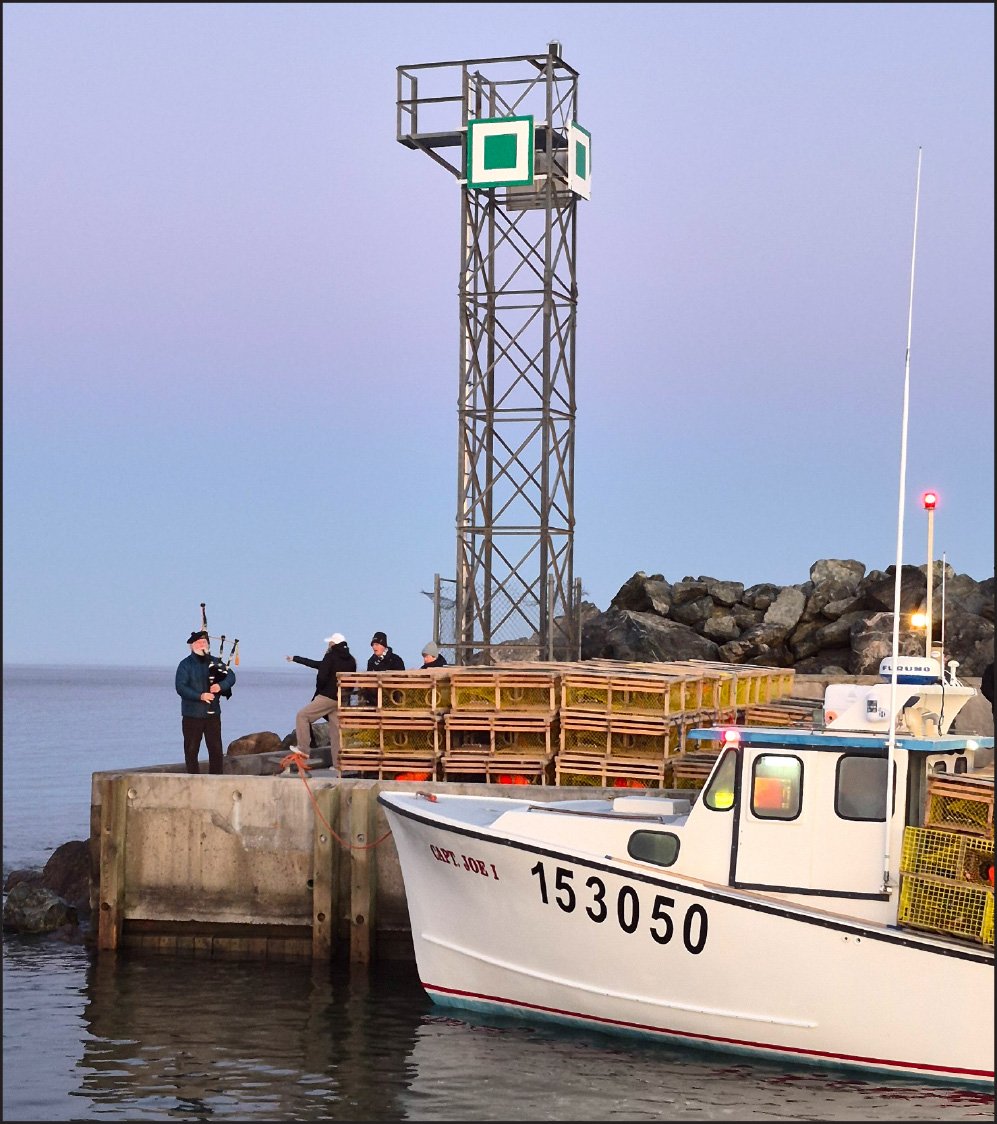


CANSO — On a quiet afternoon just before the end of the year, Bill Bond and Ken Snow sit together by the shore in Canso, talking and watching, doing what fishermen have always done when the boats are tied up and the weather allows a pause. There is food on the table. There is time to talk. There is no rush in their voices.
The calm, however, is deceptive.
Bond and Snow have spent their lives on the water. Between them, they measure their experience in decades, not seasons. They know the rhythms of the fishery, its risks and its rewards, its long stretches of uncertainty punctuated by moments of clarity. They have weathered bad years before. They have adapted. They have stayed.
“As far as me, last year, I did all right,” Bond said. “I didn’t see much of a change, to tell you the truth.”
Still, as 2025 gives way to 2026, the two veteran fishers say they are watching a convergence of pressures unlike anything they have seen before. Many are new. Together, they are reshaping the industry in ways that may determine whether there is a next generation of inshore fishers at all.
“It’s cumulative,” Snow said. “It’s not one thing. It’s the effects of everything together.”
Fishing, they are quick to note, has never been easy. It has always demanded long hours, physical endurance and a tolerance for risk. Storms come. Customers shift. Gear breaks. A good year can be followed by a bad one with little warning.
But Bond and Snow say the difference now is structural. For all who make a living by the sea here – including the hundreds of fishers and their families whose ancestors plied these waters since long before there was a Canada – costs are higher than ever before. Capital is tighter. Markets are less predictable. And environmental conditions are changing in ways that affect where fish are found and how they behave.
Trouble with turbines
As if these pressures were not enough, the prospect of massive offshore wind turbines encroaching on their fishing banks is now, quite literally, in the wind. And that, said Bond, is the single biggest worry for the entire industry.
“Nobody can tell us what it’s going to do to the fishery,” he said. “We don’t know what impact that’s going to have.”
There is, indeed, a sense of historical inevitability about the provincial government’s determination to open Nova Scotia’s famously sea-bound coast to international, national and even a few ambitious local renewable energy developers. Official communiqués and press statements speak in terms of watersheds and moments in time, of catching the next cresting wave of ocean-based wind power, of evolving into a true international player in a global industry.
Behind that language is a concrete plan: Nova Scotia, working with the federal government, has identified several offshore areas – including French Bank, Middle Bank, Sable Island Bank and Sydney Bight – for potential wind development, with the stated goal of licensing up to five gigawatts of offshore wind capacity by 2030, a process that would mark the formal launch of Canada’s first large-scale offshore wind sector.
But, said Snow, “Those are our fishing grounds. Once you start taking pieces of that away, you don’t get them back.”
Despite a year or more of public consultations, discussions and negotiations with government authorities, what troubles them just as much as the changes themselves is the sense that those who work the water are too often sidelined in the decisions that will reshape it.
Bond, a former director of the Guysborough County Inshore Fishermen’s Association (GCIFA) – the industry group representing at least 150 full-time fishers and many more whose livelihoods depend on the sector – said that experience on the water does not always translate into influence on shore.
“We’re the ones out here every day,” he said. “But a lot of times it doesn’t feel like anybody’s really listening to us.”
Snow, who is GCIFA’s president, is even blunter.
“You hear it from fishermen everywhere,” he said. “Decisions get made, and we find out after. When it comes to offshore windmills, compensation is the only word coming out of my mouth,” referring to fishers who could lose access to traditional grounds.
Call of the wild
And then, of course, there are the sharks.
Call it climate change. Call it a natural generational – if hitherto unknown – swing of the long-range weather forecast. Either way, “Jaws” is alive and well and living off the avails of Bond’s sport-fishing side gig.
“I had a tuna hooked and coming in, and a great white came up and took it,” Bond said, recalling one trip on the water off Canso this past summer. “There was nothing left but the head. That fish was no good to anybody after that.”
He’s not the only one seeing it. Great whites, once rarely discussed in these waters, are now part of regular conversation among local fishers.
“We’re seeing more of them all the time now,” Bond said. “Everybody’s talking about them.”
Snow sees it as part of a broader ecological shift.
“There’s more seals than there’s ever been,” he said. “And when you’ve got more seals, you’re going to have more sharks. It all connects.”
Taken together, the changes feel relentless – another layer of uncertainty in an industry already under pressure. This stacking effect, they said, narrows the never-fat margin for error in a business that rewards success with rarely more than a chance to come back and do it all again the next day.
All of it feeds into the question that troubles them most: not whether young people are willing to fish, but whether fishing can still make room for them.
“It’s not that they don’t want to do it – it’s whether the industry can support them,” Snow said.
Yet, for all of it, neither man is ready to walk away.
They talk instead about adapting, about finding angles, about continuing to work through problems as they always have – not out of optimism so much as a refusal to give up a way of life that has defined this coast for generations.
“We’re still trying to make it work,” Snow said. “Nobody’s throwing in the towel yet.”
As the afternoon fades, the boats remain tied up and the sea stays calm. Bond and Snow keep watching, weighing what comes next, knowing the work – demanding and unfinished – will resume soon enough on an ever-uncertain sea of change and challenge.